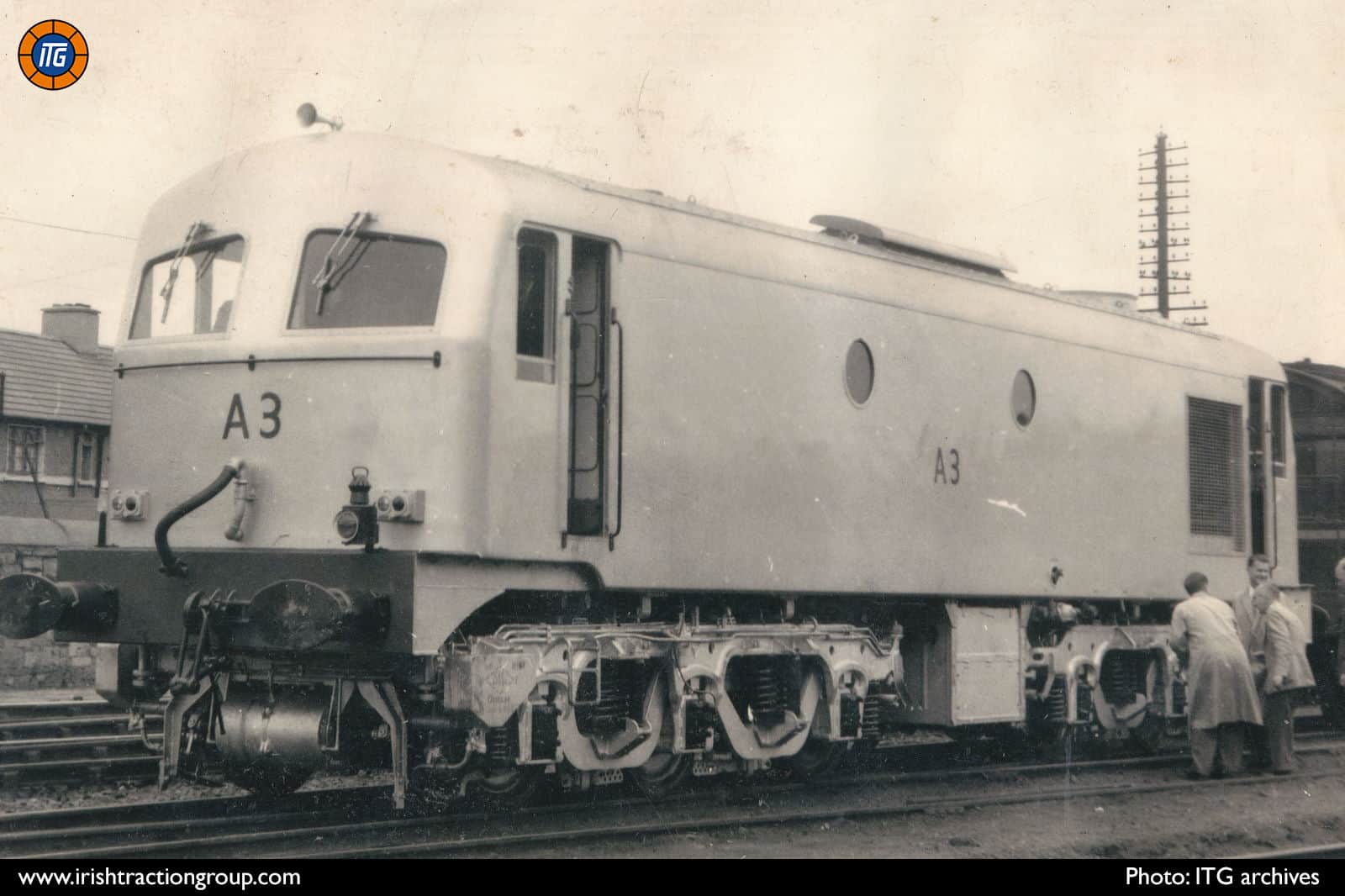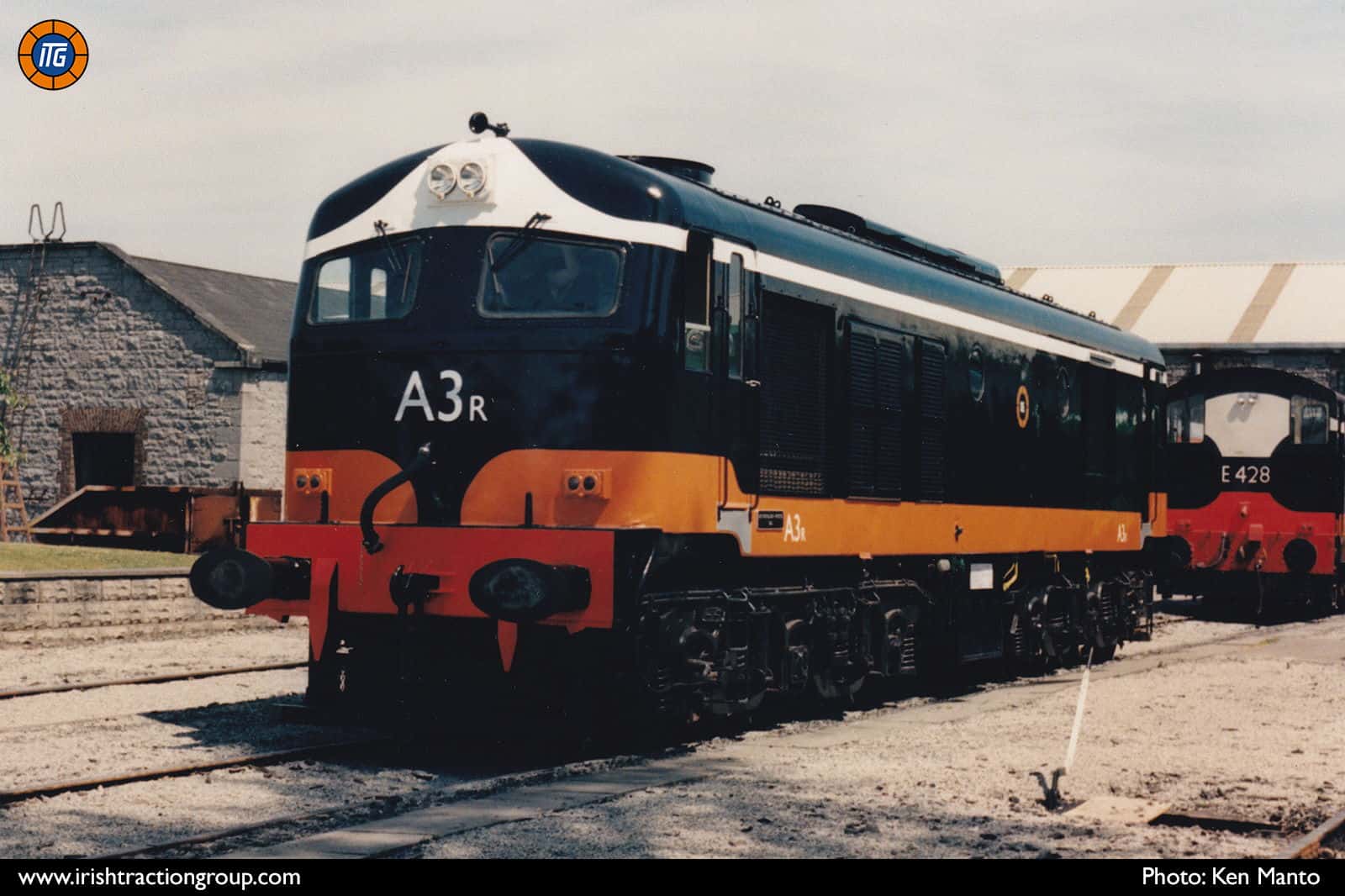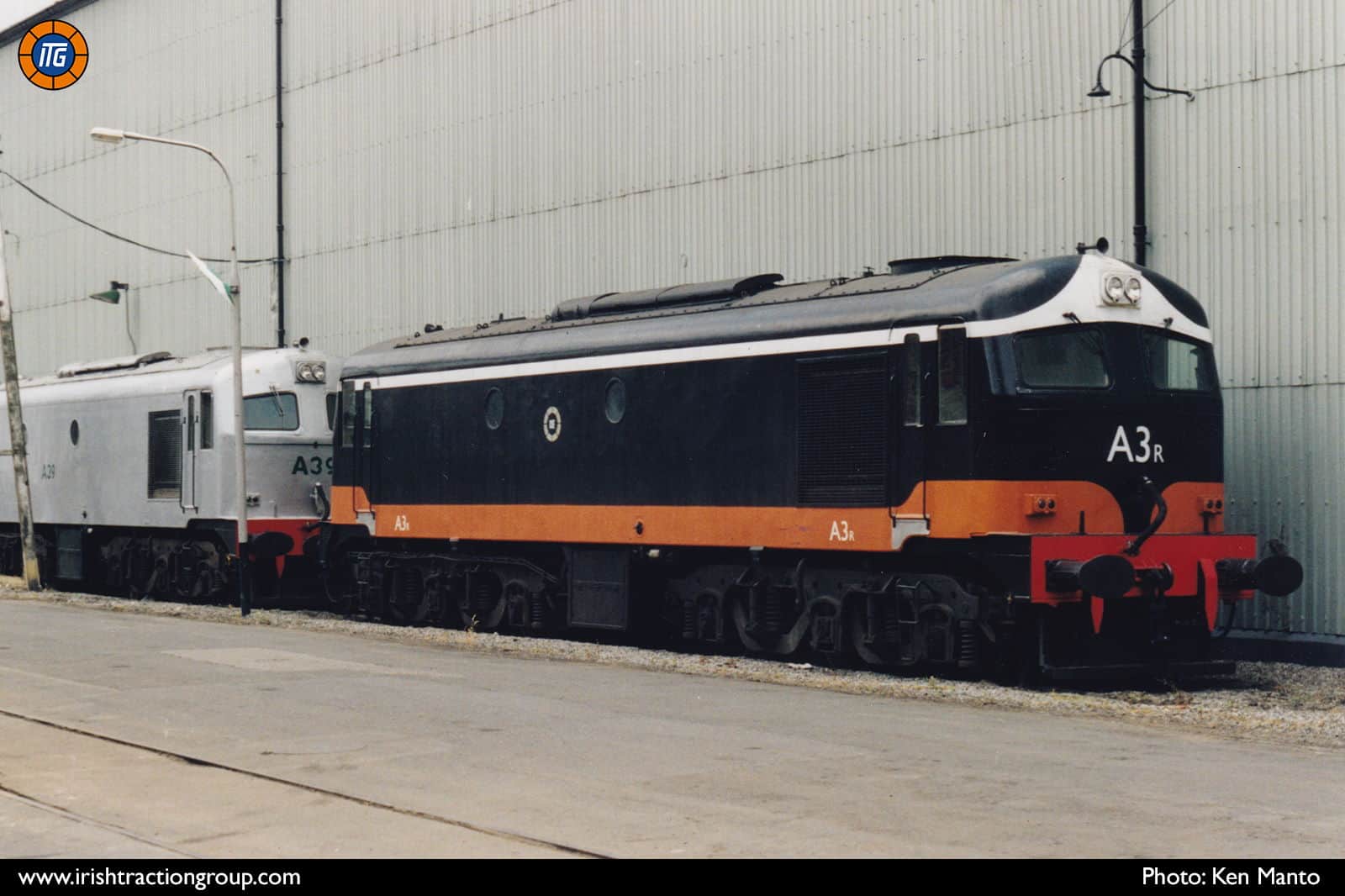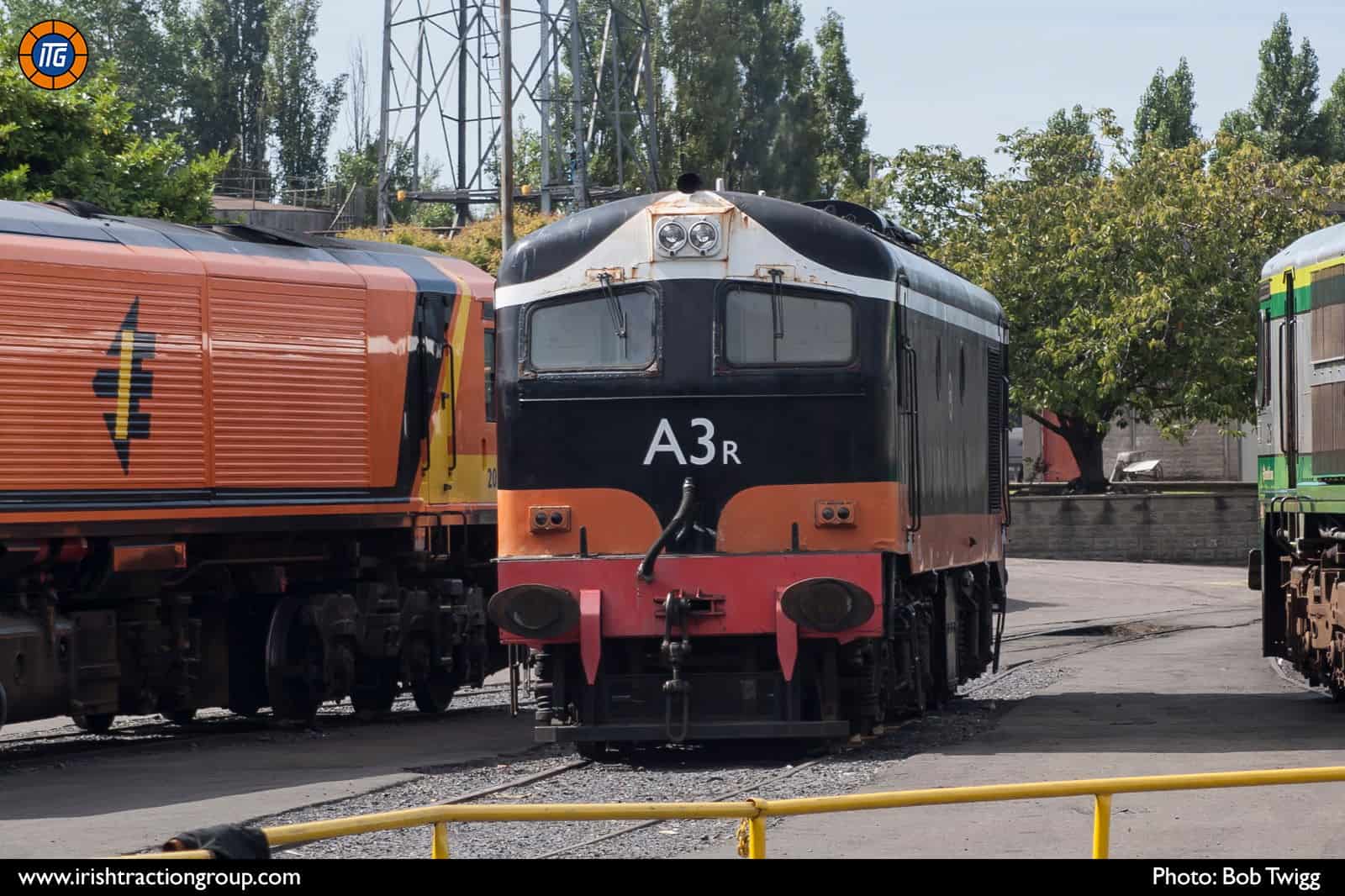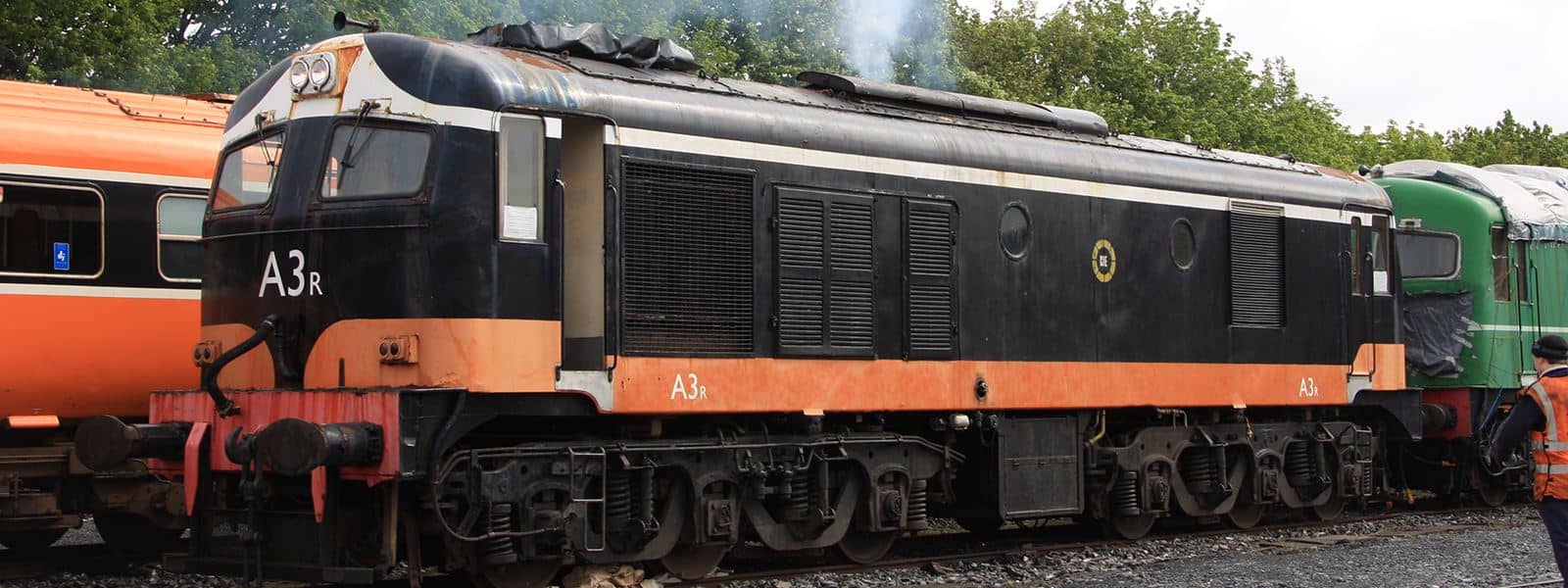
Metropolitan Vickers built locomotive A3 for Coras Iompair Éireann (CIE), the Irish State owned transport company, in their premises at Dukinfield, Manchester, in 1956. A3 was part of a class of 60 Co-
CIÉ signed the contract to build these locomotives at Kingsbridge (now Heuston) Station, Dublin, on 5th May 1954. Metropolitan Cammell constructed the bodies for the sixty ‘A’ class locomotives at their Midland Works in Birmingham between 1954 and 1956. The English Steel Corporation manufactured the bogies in Sheffield. Crossley Brothers at Openshaw, Manchester, supplied the engines. Metropolitan Vickers Electrical Co. Ltd provided the electrical components. The completed locomotive bodies were then transported by low loader to Metropolitan Vickers’ premises at Dukinfield, Manchester, for fitting of their engine/generator sets, bogies, and for testing prior to shipping to Ireland.
The first A class loco in service
A3 eventually entered traffic with CIE on 27th September 1955, being the first A class loco to enter traffic. When built, Metropolitan Vickers fitted the locomotives with a Crossley HSTV8 engine of 1200hp. However, the Crossley engines proved to be extremely troublesome and unreliable. In 1968, the decision was taken to re-
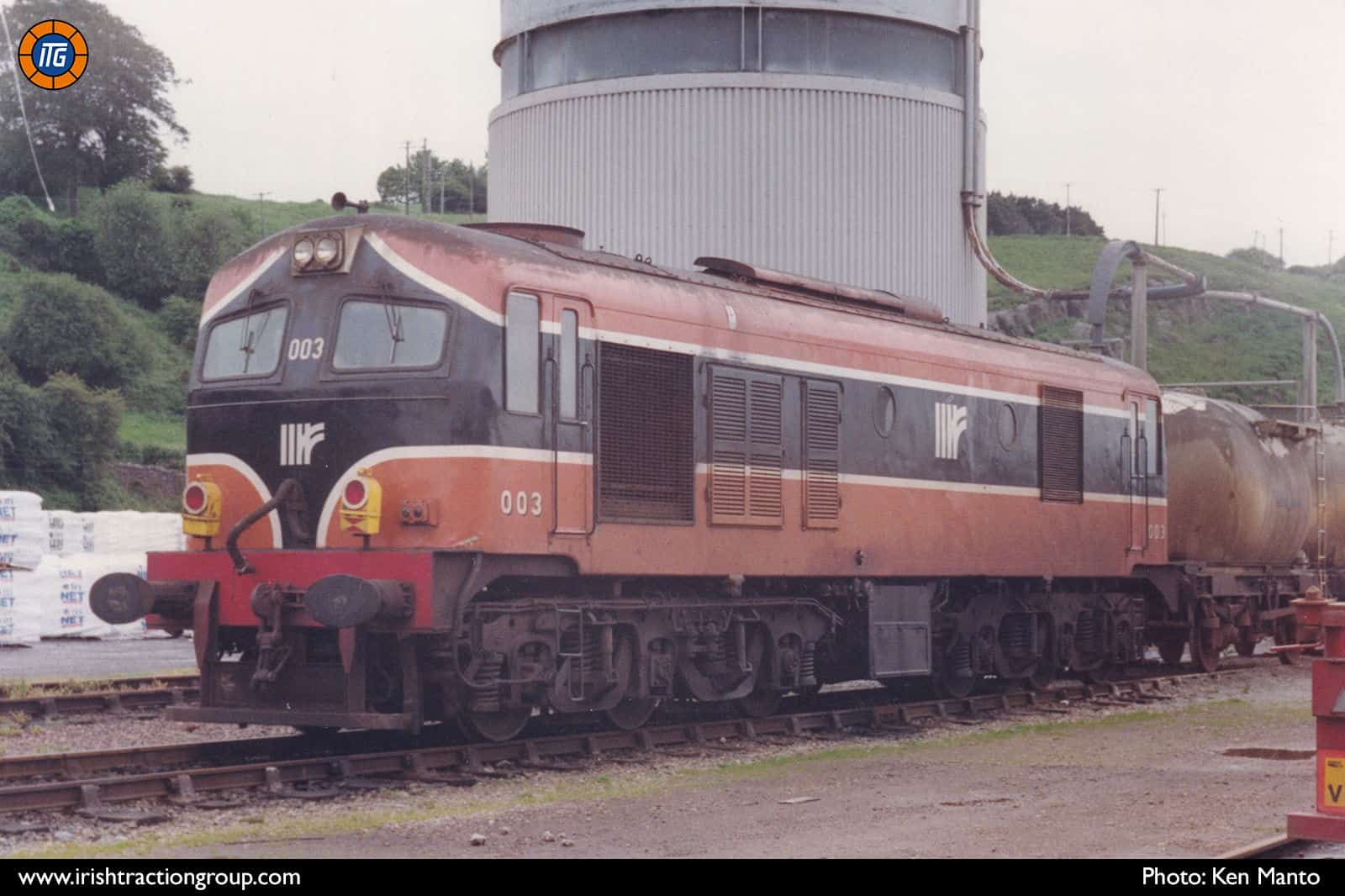
In early 1994, Iarnród Éireann asked the Irish Traction Group to nominate three examples of the 001/ A class loco for possible preservation by the Group. We selected three locomotives as being in the best condition at the time: 001, 003 and 039. We subsequently ruled out pioneer A class locomotive 001 as had a cracked fuel tank. This left 003 and 039 as the two locomotives to be preserved by the Group. We selected 003 by virtue of the fact that it was the last A class locomotive to receive a rewire and a body overhaul in 1993.
The last A class loco in service
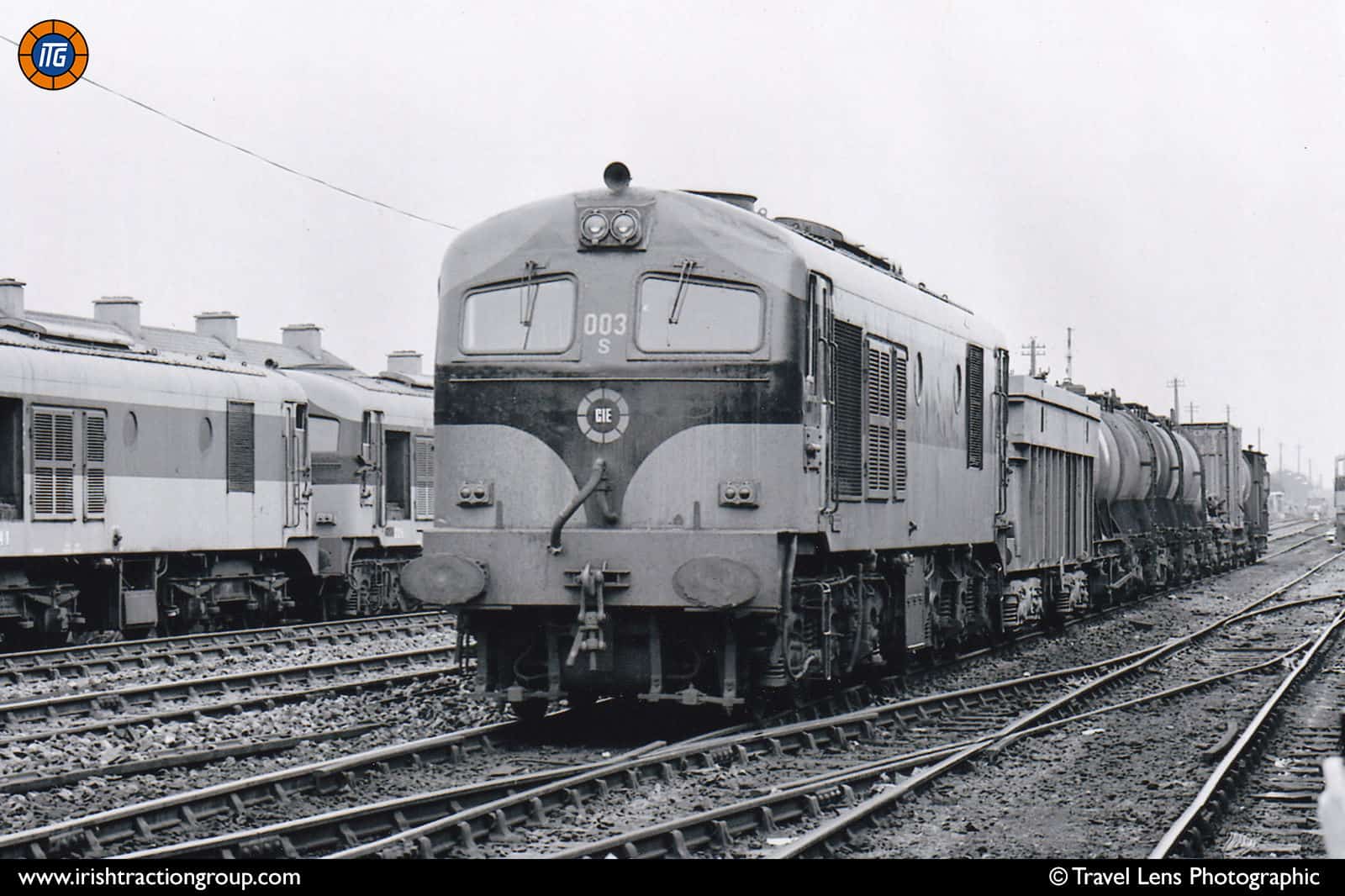
Locomotive 003 was also the last A class loco in regular service. Iarnród Éireann officially took it out of traffic on 5th April 1995. During its final few weeks in service it was based at Limerick Depot. It continued to work transferring cement wagons between Limerick and the nearby cement factory at Castlemungret. This locomotive also had the honour of hauling the last regular passenger service by a member of this class, when it operated the 09:50 Limerick to Ballybrophy and 10:20 Ballybrophy to Limerick services on 1st April 1995. Its final official working was to transfer wagons from Castlemungret cement factory to the yard at Limerick on 5th April 1995.
However, this was not the end for 003, as staff at Limerick kept 003 in working order. It still performed occasional shunting duties at Limerick Wagon Works. However, 003 was only running on four traction motors at this time, both the defective motors being on the same bogie.
Following the ‘farewell’ railtour utilising locomotive A39 on 23rd September 1995, everybody thought that this was going to be the last passenger working of an A class loco in Iarnród Éireann ownership, but this proved to be incorrect. Just two weeks later, 003 put in a very welcome, if totally unexpected, appearance on the ITG’s ‘Flying Pig’ railtour, when it was used to haul the railtour the short distance between Limerick station to Limerick Check and back on the section from Limerick to Foynes. Thus, 003 proved to be the last A class locomotive to operate under Iarnród Éireann ownership.
A3R is preserved
The ITG purchased locomotive 003 for preservation on 6th December 1995. The Irish Heritage Council aided this with a grant of I£ 10,000. At this point 003 remained stored at Limerick Depot. As part of the sale agreement, Iarnród Éireann had agreed to replace the two defective traction motors. On Saturday 9th March 1996, another locomotive hauled 003 to Limerick Junction and back. This was done to enable the locomotive to be turned on the triangle at Limerick Junction, so that the bogie with the defective motors could be positioned under the overhead gantry crane within the main workshop.
However, following further testing, it was found that a third motor, on the other bogie, was also defective. Three recently overhauled traction motors were then sent down from Inchicore Works to Limerick and were fitted during mid-
Exhibitions
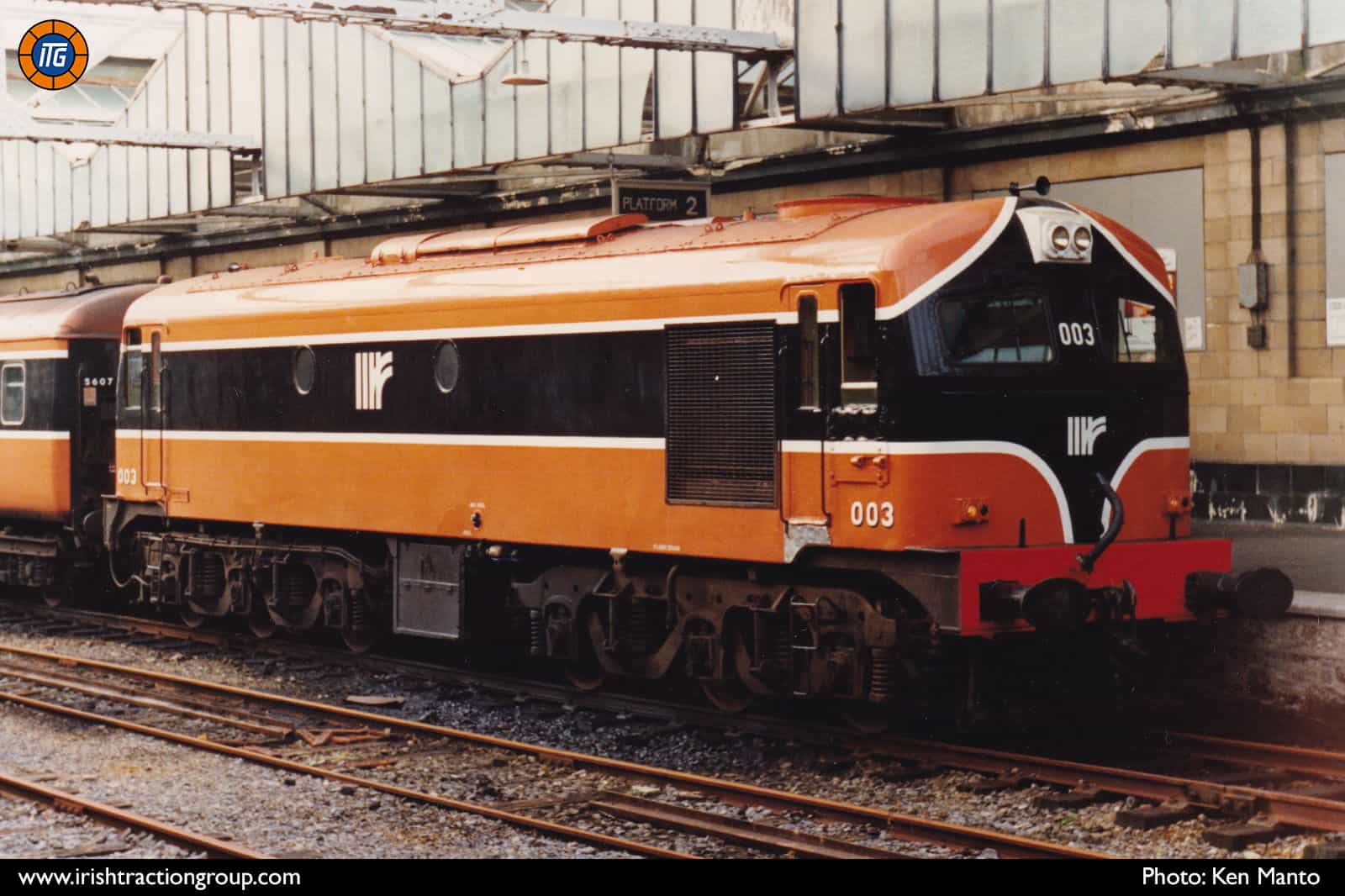
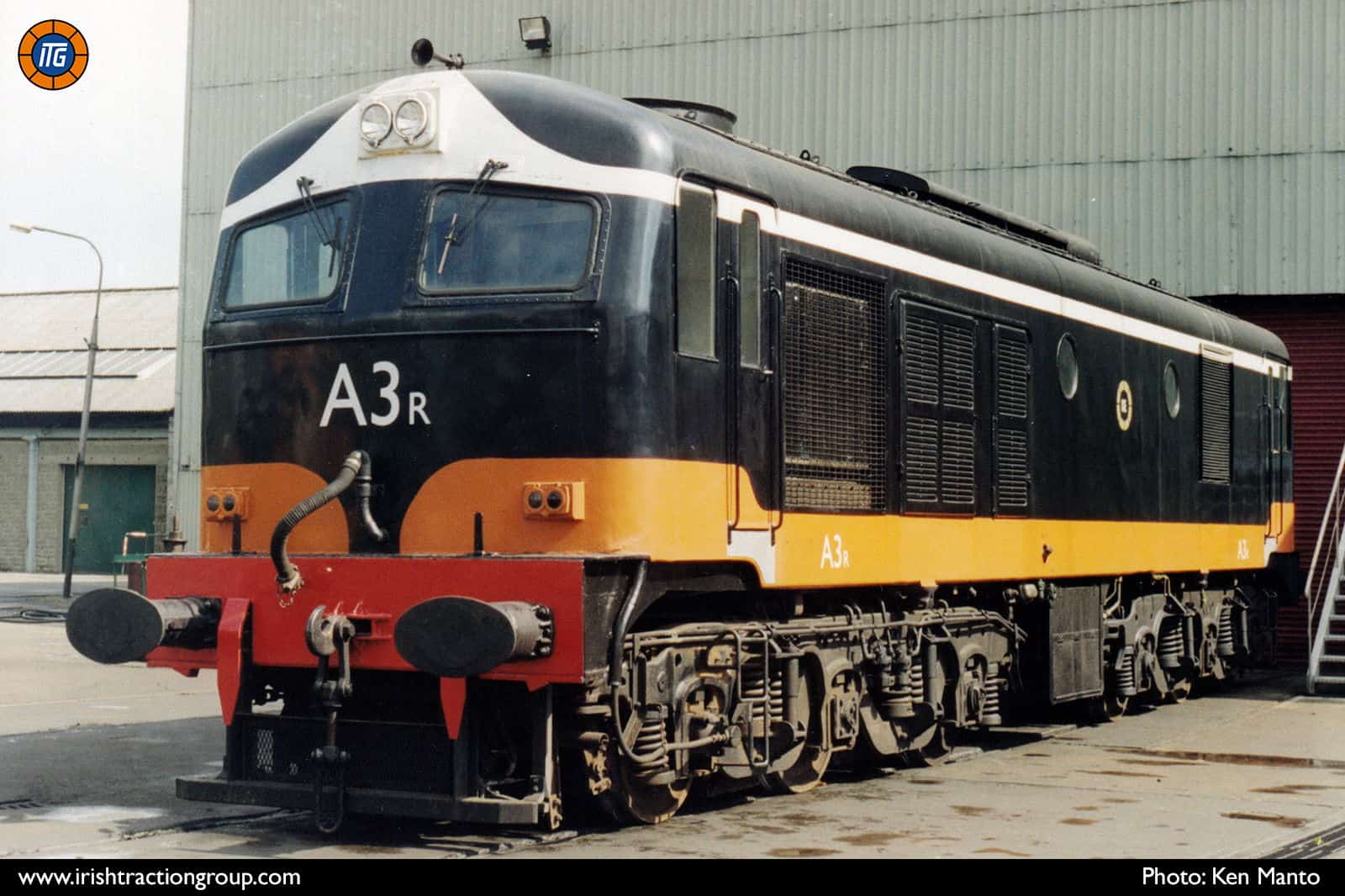
At around this time, IÉ began preparations for the ‘Inchicore 150’ anniversary celebrations over the weekend of 15th/16th June 1996. They invited the Group to attend with 003. An IÉ GM hauled 003 from Limerick to North Wall on Saturday 8th June 1996. Another locomotive then tripped A3R from North Wall to Inchicore Works the following morning and placed it in the Diesel No. 2 Shop. Our volunteers immediately commenced on repainting the locomotive into ‘black and tan’ livery. We also renumbered the locomotive back to A3R.
The ITG team finished the repaint just a few hours before the gates opened. Shunters placed locomotive A3R at the head of a display of diesel locomotives outside Diesel No. 2 Shop for the duration of the event. Following the ‘Inchicore 150’ event, IÉ returned A3R to Limerick for storage on 8th July 1996. A3R stayed at that depot for the next two years or so. The locomotive did venture out briefly once during this period. We exhibited A3R at Thurles station on 6th April 1998.
Return to the mainline
Following our securing of the necessary insurance cover to enable the ITG to operate its locomotives under their own power on Iarnród Éireann tracks, an IÉ locomotive hauled A3R up from Limerick to Inchicore Works over the weekend of 18th/19th December 1998. Here, staff refitted CAWS and train radio equipment to the locomotive. We then started work to certify the locomotive as fit for main line running. We completed this work on 1st March 1999. Examiners certified the locomotive as fit the following day.
Its first booked passenger working was due to be on the ‘Back in Black’ railtour on Saturday 27th March 1999. Its first run under its own power on Iarnród Éireann tracks under ITG ownership was on 23rd March 1999. On this date, A3R ran light engine to Kildare and back. The fuel pump burnt out just before the locomotive was due to leave Inchicore Depot. This delayed the run by two hours. We replaced the pump with one recovered from spares donor locomotive 015.
Mainline test runs
A second loaded test run took place on 25th March 1999, when A3R hauled a rake of steam vans and Cravens coaches to Lisduff and back. All went well on the outward journey, but A3R started to suffer from a loss of vacuum on the return journey. A fault also developed with the train radio. Unfortunately, we could not repair the faults in time for the railtour on 27th March 1999, and so locomotive A39 took its place. Following repairs, A3R hauled another loaded test run to Portlaoise and back on 17th May 1999. It did so in preparation for its next booked appearance on the ‘Mayo Metro-
A successful railtour
On Friday 11th June 1999 locomotive A3R ran light engine from Inchicore Depot to Dublin Connolly ready to work the railtour.
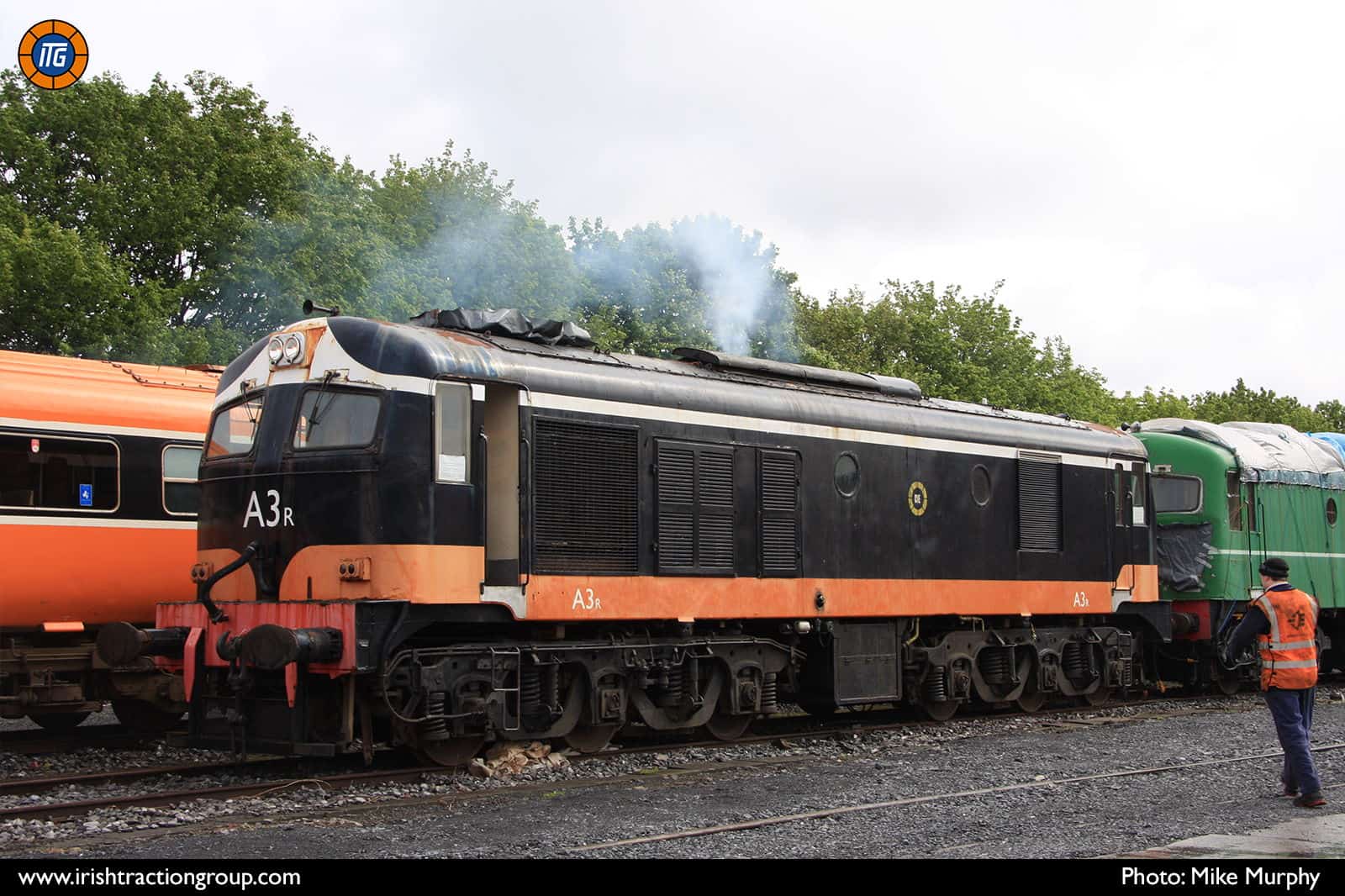
A3R operated faultlessly on the day, working the train from Dublin Connolly to Ballina and back. The locomotive put in an impressive, if somewhat smoky performance. A3R returned to Inchicore Depot light engine two days later.
Locomotive A3R’s next scheduled appearance was to be on Saturday 9th October 1999, operating the ‘Leitrim Leprechaun’ railtour from Dublin Connolly to Dromod, and back to Bray. However, a few days before the railtour, locomotive A3R developed a serious vibration problem with its cooling fan. A39 hauled the railtour instead. We fitted a replacement cooling fan motor on 9th November 1999, but this did not rectify the vibration problem. At this point the ITG decided not to renew its main line insurance cover due to the excessive cost and dwindling passenger numbers. The Group put the repair work to A3R on hold indefinitely.
Storage at Inchicore
Between 2000 and 2008, we kept the locomotive stored out of use at Inchicore Works. We carried out very little work on, aside from efforts to protect it from the elements. However, after we completed estoration work on A39 in early 2009, we restarted on A3R in order to try to return locomotive to working order once again.
Our team removed the old batteries. They were no longer fit for purpose so we safely disposed of them. Over the next few weeks, we acquired and fitted replacement batteries. Our volunteers also checked the brushes, brush arms and commutators in the main and auxiliary generators. We also replaced some of the starting contactors as they were sticking. We barred the engine over; it was relatively free. It had been several months since it had last been done. Our volunteers removed the tarpaulin that had been covering the locomotive. We took off the plastic sheeting from over the exhaust ports. Volunteers had fitted these when they draiend the engine down in November 1999. It had done its job well. We filled the locomotive’s cooling system and treated the fuel tank with biocide. We also poured oil over the top of the cylinder heads, camshafts and injectors inside the cam boxes.
A successful restart
On Saturday 9th May 2009 ITG volunteers successfully restartd the engine in locomotive A3R for the first time since November 1999. However, A3R shut down after a short period due to a faulty battery. Our volunteers replaced the defective battery. Next we restarted locomotive A3R and found all to be well. After a couple of hours the engine sounded quite smooth while it was running. The smoke that it was giving off when it first started had disappeared. The auxiliary generator also appeared to be charging the batteries correctly.
Fault finding
As the locomotive had been out in the open for several years, the traction motors would no doubt have been rather damp. As such, we made no attempt to move the locomotive under its own power until further work had been carried out. However, we found that the the air system was working as it should. However, we did discover that one horn valve and one wiper motor were not working, both on the second man’s side in No. 1 cab.
The heaters in both cabs were operating correctly, as were the headlights and marker lights at both ends. The hot plate in No. 1 cab was working, but not the one in No. 2 cab. We also discovered that the bulb in the No.1 cab light had blown. Otherwise, the only non-
We filled the locomotive’s engine with coolant. Then, we discovered a leak on the water pump that is bolted onto the engine. It was particularly bad when the engine was cold. We subsequently drained the water out of the cooling system and dismantled the water pump. In mid-June 2009, we repaired the pump and re-assembled it using new seals. Then we reattached water pump was to the engine and reconnected all the water pipes. After refilling the water system, we engine barred over.
On 20th June 2009, our volunteers restarted the engine and allowed it to run for around three hours. We did this to help recharge the batteries. However, we did not allow the engine to run any longer as the cooling fan motor fuse had been temporarily removed pending repairs to the defective fan motor.
Fan motor problems
In July 2009, our volunteers removed the fan blade from the cooling fan motor. We did this to find out the reason for the excessive vibration that resulted in A3R being stopped back in 1999. Once the blade was off, volunteers attempted to turn the fan motor by hand. They found it to be very stiff. It should have rotated very easily. We greased the bearings on the fan motor and replaced the fuse. This was so that we could attempt to test the motor properly.
The fan started to turn when we first switched it on. However, it rapidly stopped once we switched off the power. After a few more attempts we freed up the fan motor. Eventually it started to rotate quite freely. We refitted the fan blade to the motor and replaced the protective grill. Volunteers tested the fan once again. It revolved well enough without any rattles and bangs. However, the cooling fan motor did not appear to be kicking-in at the correct speeds as the engine temperature rises.
We need to carry out further examination of the wiring in the fan motor control box still. We also need to look at the thermostats that control the fan speed. However, with the need to remove this locomotive from Inchicore works, Dublin, by the end of November 2009, we had to stop work on returning locomotive A3R to full working order for the foreseeable future.
Beyond Inchicore
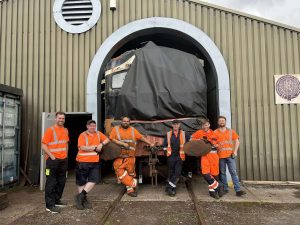
In November 2009, we moved locomotive A3R by low-loader from Inchicore Works, Dublin, to the West Clare Railway, Moyasta, Co. Clare. The site owner intended to display the loco in a planned museum. Unfortunately the planned museum has not come to fruition (yet), We moved A3R to the Downpatrick & County Down Railway museum, over 26/27th July 2025, where its sister A Class loco, A39R, is already based.